
Brand Usage Guidelines
As of October 27, 2026
1. Scope and Purpose of the Policy
ZenDiS is a federal government agency that develops and provides open-source software for public administration and other users, in particular the “openDesk” office and collaboration suite and the “openCoDE” platform. openDesk is available in two versions: (i) openDesk Enterprise Edition and (ii) openDesk Community Edition.
This Trademark Usage Policy specifies the conditions under which third parties may use registered trademarks and other distinctive signs to which ZenDiS holds rights (collectively, the “ZenDiS Trademarks,” listed in detail in Section 2) for their own purposes.
The purpose of this policy is to ensure that the ZenDiS trademarks reliably indicate the origin and quality of the ZenDiS software and that confusion is avoided, while allowing the community, partners, and users to actively use and discuss the ZenDiS software.
Important to know: ZenDiS software is provided under open-source licenses. These licenses grant rights exclusively to the relevant source code but do not include any rights to use the ZenDiS trademarks. Unless otherwise provided for in this policy, contractual agreements, or legal provisions, these rights remain with ZenDiS.
Compliance with this policy is mandatory for anyone who uses or wishes to use the ZenDiS trademarks—regardless of whether they use ZenDiS software.
2. Scope and Trademark Ownership
This policy covers all marks in which ZenDiS holds rights, in particular:
the registered word marks and word/figurative marks
“openDesk” (DE No. 302023011022, EU No. 019042176, CH No. 820444),
“ZenDiS” (DE No. 3020211154835),
“openCoDE” and “openCode” (DE No. 302021115484, DE No. 302021118707, DE No. 302021118708);
the designations and associated logos
“openDesk Approved Sovereign Service Provider” (ASSP),
“openDesk Approved System Integrator” (ASI),
“Official openDesk Distributor”,
“openDesk Enterprise Edition” and
“openDesk Community Edition”;
the graphic representations of all the aforementioned designations in the variants provided by ZenDiS (color, grayscale, icon).
The following illustrations show the logos covered by this guideline in their respective original versions:
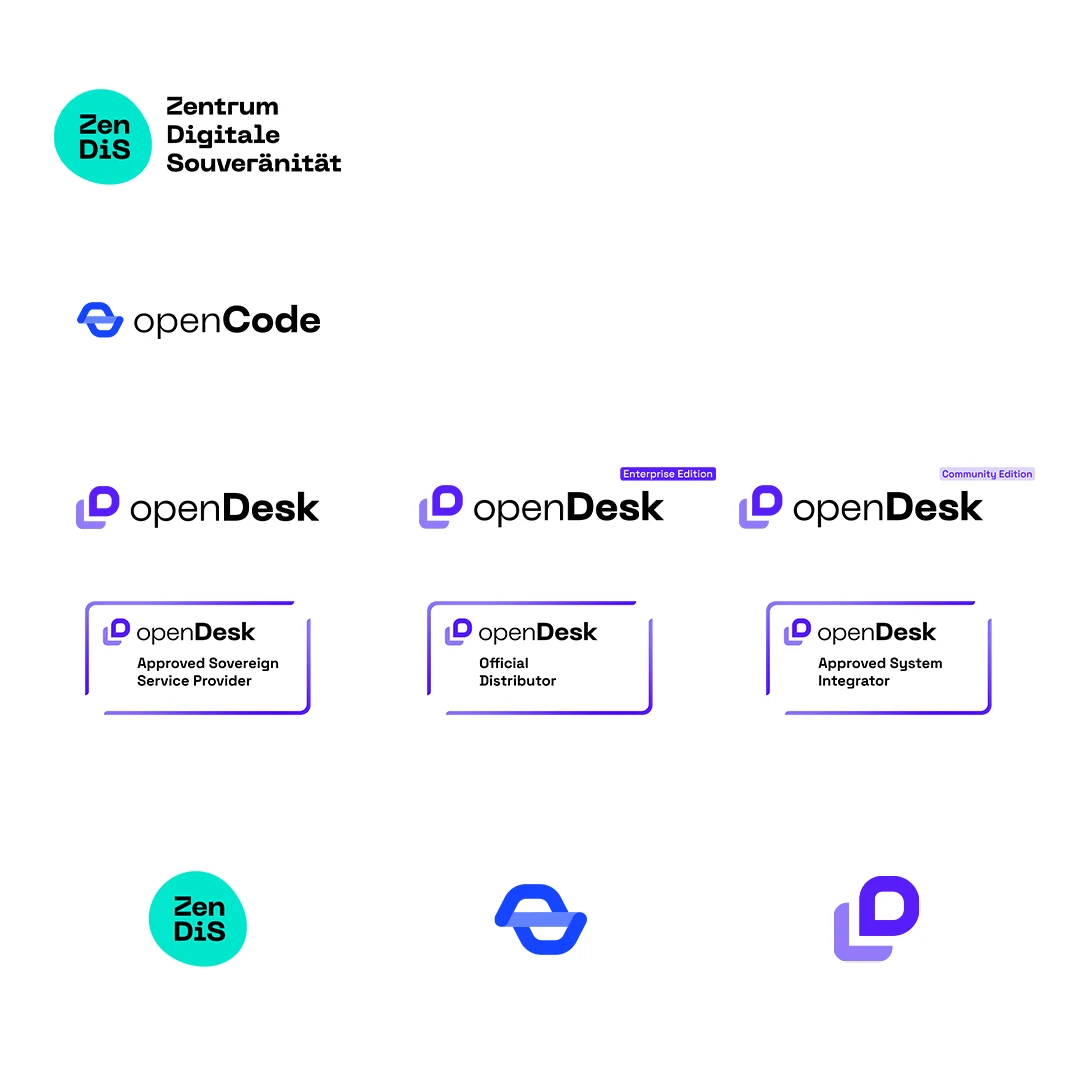
3. General Provisions
3.1 Principle of Consent
The use of ZenDiS trademarks generally requires the prior written consent of ZenDiS. This also applies to their disclosure to third parties. Consent is not required if the use or disclosure is expressly permitted under the provisions of this policy.
Inquiries should be directed to the contact point specified in Section 8.
ZenDiS’s consent is required in particular in the following cases:
any commercial use of the ZenDiS trademarks, in particular in one’s own product names, on promotional materials, or on merchandising items for one’s own products;
the use of the ZenDiS trademarks or confusingly similar variations thereof in domain names, social media profile names, or app names;
describing a product, service, or offering as “certified by,” “official,” “compatible with,” “openDesk Ready,” “openDesk Compatible,” “openDesk Certified,” or otherwise formally associated with ZenDiS;
the use of ZenDiS trademarks in the context of solicitations, procurement procedures, or public references, to the extent that this could create the impression of a special relationship with ZenDiS that does not actually exist;
the use of a ZenDiS logo outside the limits described in Section 3.7;
any use in the context of a distributor, CSP, integration, or other partnership with ZenDiS, whereby such use is governed by the terms set forth in the respective agreement with ZenDiS;
Approval is likely to be denied in the following cases:
the use of a ZenDiS trademark or logo as part of a company name or legal entity name;
the designation of an independent, modified version of the ZenDiS software under a ZenDiS trademark;
any use that disparages the reputation or standing of ZenDiS or the ZenDiS trademarks and is not clearly recognizable as a permissible expression of opinion by a third party;
the use of ZenDiS trademarks to market non-proprietary third-party products (e.g., G Suite, Microsoft 365) as proprietary solutions; The marketing of openDesk as a BCM/emergency solution remains unaffected by this provision.
3.2 Principle of Transparency
In particular, the use of ZenDiS trademarks must not give the impression that a modified version is being distributed as unmodified ZenDiS software, nor suggest any endorsement, sponsorship, or affiliation of the modified version with ZenDiS. It is, however, permissible, under the given conditions, to truthfully state or publish that ZenDiS software is being used, that someone is participating in the community, or that an unmodified version is being provided.
3.3 Modified Versions (Derivative Works)
Products and services may only be distributed, advertised, or otherwise used or exploited under the respective ZenDiS trademarks if they exclusively use the software components approved and/or licensed by ZenDiS and the integration layer provided by ZenDiS, each in an unmodified form. A modification in this sense is deemed to occur, in particular, if the ZenDiS software components or the integration layer are altered—through customizations, supplemented or altered with additional proprietary modules or a different configuration, replaced with an independently developed integration layer, or combined with software components not approved and/or licensed by ZenDiS (e.g., in the case of a fork). In such cases, distribution, promotion, or any other use or exploitation under the ZenDiS trademarks is prohibited.
3.4 Referential Use (Citation)
The ZenDiS trademarks may be used unaltered in texts (e.g., product descriptions) to truthfully refer to the relevant ZenDiS software, its functions, or the relationship of the user or the user’s product to ZenDiS or the software. References are not permitted if they give the impression of certification, compatibility testing, or other collaboration with ZenDiS that does not actually exist (see Section 3.1(c)).
Permissible examples include:
“[Name/Company/Product] uses openDesk”;
“[Product] is part of openDesk”.
If one of the ZenDiS trademarks is used to designate a ZenDiS product in the context of a reference, it must always be used as an adjective preceding the descriptive noun (e.g., “the Office & collaboration suite openDesk”). However, it is not permitted to use a ZenDiS trademark in the plural or in a possessive form, to abbreviate it, or to combine it with other terms to form a new (coined) word (e.g., “openDesk-Pro” or “MyopenDesk”).
3.5 Media Coverage
The mention of ZenDiS trademarks in editorial articles, reviews, training materials, academic papers, professional publications, and similar publications is permitted, provided it remains clear that the statement is an independent opinion and not an official statement from ZenDiS.
3.6 Communities and User Groups
The ZenDiS trademarks may be used in the name of a user group or community event that deals with openDesk or other ZenDiS offerings in terms of content, provided that:
the group’s primary focus is on a ZenDiS offering (e.g., openDesk, openCode);
the group is not organized for profit;
any participation fees are used exclusively to cover room, catering, or similar costs;
no impression is created that the event is an official ZenDiS event or an official ZenDiS conference when this is not actually the case.
3.7 Logos
If the use of any of the word/figurative marks or logos listed in Section 2 is permitted, the following guidelines apply, as well as the provisions of the ZenDiS Style Guide, which is available upon request from the contact point specified in Section 8:
The logo must always be used in its original form; it may be scaled proportionally but must not, in particular, be distorted, rotated, colored, or otherwise altered;
The logo must not be combined with other logos, symbols, or trademarks to form a new combined mark;
Sufficient space must be left around the logo so that it is not obscured or impaired by other elements;
In the case of an altered, derivative, or otherwise modified version of ZenDiS software, the respective logo must be completely removed (Section 4.3 remains unaffected);
Any other use of a logo that impairs its recognizability or alters its overall visual appearance in a manner contrary to the above guidelines is prohibited.
3.8 Attribution
For any permitted use of the ZenDiS trademarks not covered by Section 3.5, the following notice or a notice with the same meaning must be included in a suitable location (e.g.,B. in the legal notice or footer), the following statement or an equivalent statement must be included, unless this is already clearly evident from the context of the use: “[Specific ZenDiS trademark(s)] is/are a registered trademark(s) or designation(s) of ZenDiS GmbH.”
The notice must be placed and formatted (e.g., in terms of font size, contrast, and positioning) in such a way that it is readily perceptible and legible to an average viewer; a statement that is merely technically present but not actually perceptible (e.g., in very small font, in a hidden location, or exclusively in the source code) does not meet these requirements.
In cases where the impression of a connection to ZenDiS could be created without such a connection actually existing, it must also be made clear that there is no sponsorship, endorsement, or other affiliation with ZenDiS, unless this is already unambiguously evident from the context.
4. Special Terms for the openDesk Community Edition
The openDesk Community Edition is freely accessible and may be reused in a wide variety of ways, provided the applicable license terms are observed. The following special rules apply to its attribution, ensuring that the origin and quality of the openDesk Community Edition remain recognizable to third parties at all times.
4.1 Use of the openDesk Community Edition, Distribution
The openDesk Community Edition must always be identified by the designation “openDesk Community Edition,” supplemented, if applicable, by the corresponding extended logo. The designation “openDesk” alone, as well as the use of the openDesk logo without the addition of “Community Edition,” is not permitted. This also applies in the case of distributing a copy of the openDesk Community Edition, provided that it is distributed unchanged. In the case of modifications, Section 4.3 applies.
4.2 Offers of the openDesk Community Edition
Anyone offering the openDesk Community Edition on the market without modification must comply with the following requirements:
The offering must be consistently designated as “openDesk Community Edition” and labeled accordingly; only the extended “openDesk Community Edition” logo provided by ZenDiS may be used;
In all materials (particularly the website, sales and promotional materials, screenshots), it must be clearly stated that this is the openDesk Community Edition and what limitations are associated with it, in particular:
no manufacturer support, no service levels, and no provision of patches by ZenDiS (Overview available at: https://docs.opendesk.eu/operations/enterprise/);
Exclusion or limitation of warranty and liability in accordance with the relevant open-source licenses, specifically the Apache License 2.0 for deployment automation (available at: https://gitlab.opencode.de/bmi/opendesk/deployment/opendesk/-/blob/develop/LICENSE) as well as the respective licenses of the included components (https://docs.opendesk.eu/operations/introduction).
4.3 Modified Versions (Derivative Works)
If a modified version (Section 3.3) of the openDesk Community Edition is used or made available for use, the following applies:
All openDesk logos must be removed from the modified version;
the term “openDesk” may be used exclusively in a descriptive manner to truthfully indicate the origin (see Section 3.4);
Your own trademarks or logos, which are sufficiently distinct from the ZenDiS trademarks, may be affixed to the modified version; however, the modified version may not, in particular, be called “openDesk” itself or be used or distributed under a name that contains “openDesk” or is confusingly similar to it (Section 3.8 regarding the indication of origin remains unaffected).
5. Special Terms for openDesk Enterprise Edition and Authorized Partners
The openDesk Enterprise Edition, as well as collaboration with authorized partners, is governed by commercial subscription or partner agreements with ZenDiS.
5.1 openDesk Enterprise Edition
The designation “openDesk” or “openDesk Enterprise Edition” may only be used for a proprietary product or offering if all of the following conditions are met:
the provider or user has purchased the required subscriptions from ZenDiS or an official distributor;
the product or offering corresponds to a product configuration (component composition, bundle) authorized by ZenDiS; authorization is based on objective criteria specified by ZenDiS in the respective partner agreement or a document referenced therein, in particular regarding the technical compatibility, security, and interoperability of the components.
5.2 Authorized Partners
The right to use the designations “Official openDesk Distributor,” “openDesk Approved Sovereign Service Provider” (ASSP), and “openDesk Approved System Integrator” (ASI), as well as the right to use the respective logos, is granted exclusively and directly by ZenDiS within the framework of the respective partner agreement (Distributor Agreement, ASSP Agreement, or ASI Agreement). The nature and scope of trademark use, including the right to sublicense, are governed by the provisions set forth in those agreements. The general guidelines in Section 3.7 also apply to the use of the logos. In the event of any conflict between this policy and such an agreement, the latter shall prevail.
6. Enforcement and Violations
ZenDiS reserves the right to review any use of the ZenDiS trademarks and to take appropriate measures in the event of violations of this policy. These include, in particular, a demand to cease or modify such use and, if necessary, the assertion of further legal claims. In particular, ZenDiS may revoke any granted consent to use with future effect if the user fails to comply with a justified request to cease or modify such use within a reasonable period of time or if there is a material violation of this policy; such revocation must be exercised in a proportionate manner, taking into account the interests of both parties, in particular the severity of the violation and the economic consequences for the user.
In case of doubt regarding the permissibility of a planned use of the ZenDiS trademarks, the contact point specified in Section 8 should be informed prior to commencing use, and consent should be awaited.
7. Amendments to This Policy
ZenDiS may amend this policy with future effect to the extent necessary to adapt to changes in legal requirements, to further developments in the ZenDiS software, changes to the product and package structure of openDesk or the partner program, or to adapt to comparable circumstances that were unforeseeable at the time the agreement was concluded. The current version is published at www.zendis.de/markennutzung.
For users without their own partner agreement with ZenDiS, an amended version applies to acts of use as of its publication; consents already granted remain unaffected by the amendment, unless otherwise agreed. If an amendment to this policy results in a material and unreasonable deterioration of a partner’s contractual position, the partner is entitled to terminate the partner agreement affected by the amendment for good cause.
8. Contact
For questions regarding this policy, the use of the ZenDiS trademarks, or to obtain separate authorization to use the ZenDiS trademarks, please contact:
Lutz Niemeyer, Communications Manager, Center for Digital Sovereignty in Public Administration (ZenDiS) GmbH
Email: lutz.niemeyer@zendis.de